Use from the SDK
Install the client next to the SDK on the machine that creates sandboxes. It needs only the issuer key: set BEACHSIDE_BROKER_ISSUER_KEY to the issuer key that bun run deploy:setup printed, and BEACHSIDE_BROKER_URL to the broker’s origin.
npm install beachside @beachside/credential-clientCreate the broker client with the issuer key, and pass broker.sandbox() as the sandbox’s grant.
import { createCredentialBroker } from "@beachside/credential-client";
const broker = createCredentialBroker({  url: process.env.BEACHSIDE_BROKER_URL!,  auth: { apiKey: process.env.BEACHSIDE_BROKER_ISSUER_KEY! },});
const result = await client.sandboxes.with(  {    network: "internet",    grant: broker.sandbox({ integrations: ["github", "openrouter"], ttlSeconds: 3_600 }),  },  (box) => box.exec(["printenv", "OPENROUTER_BASE_URL"]),);
Each integration’s variables follow its kind, as in the CLI:
| Integration | Variables |
|---|---|
| GitHub | git and gh configuration. See GitHub access |
| Anthropic, OpenAI or OpenRouter kind | ANTHROPIC_*, OPENAI_* or OPENROUTER_*: _BASE_URL and _API_KEY |
HTTPS endpoint, which integration setup creates |
<ID>_BASE_URL and <ID>_API_KEY, so openrouter sets OPENROUTER_* |
To choose the names, list the integration in endpoints instead:
broker.sandbox({ endpoints: [ { integration: "openrouter", baseURLEnv: "OPENAI_BASE_URL", apiKeyEnv: "OPENAI_API_KEY" }, ],});The base URL variable already includes the path the integration was registered with. For OpenRouter that is .../gateway/openrouter, standing for https://openrouter.ai/api/v1, so a client that appends /chat/completions works as is. Pass the broker URL explicitly to a client that does not read the variable.
Lifetime and renewal
Section titled “Lifetime and renewal”The SDK acquires the grant once the sandbox exists and before setup runs. It applies the variables to every command, process and terminal started through that client, including handles reopened on the same client. A handle reopened through a new connection, or a native SSH session, does not have them. When you need the grant in every process, from any client, use the CLI, which writes it into the sandbox’s environment.
box.grant(); // { status: "active", id, integrations, env: [...names], expiresAt, renewable }await box.renewGrant({ ttlSeconds: 7 * 24 * 3_600 });The SDK’s default lifetime is 15 minutes, and the broker allows up to 7 days. renewGrant() moves the expiry to ttlSeconds from now and keeps the token. After expiry or revocation, the handle stops starting commands. The broker checks each request on its own, so a process that already has the grant also stops working.
box.destroy() and the end of sandboxes.with() revoke the grant. So does a failed setup, even with onSetupFailure: "keep". If revocation fails, SandboxCredentialRevocationError carries the destroy result, and the grant expires on schedule. Credentialed sandboxes cannot be snapshotted or forked, and submitCreate() refuses a grant.
A grant needs a network that reaches the broker. network: "blocked" is refused. See the network notes for providers that limit outbound traffic.
Refused grants
Section titled “Refused grants”If the broker refuses a grant, the error says why and how to fix it: an unknown integration, a disabled one, or one the issuer may not grant yet (“Run beachside broker issuer allow openrouter”).
OpenCode
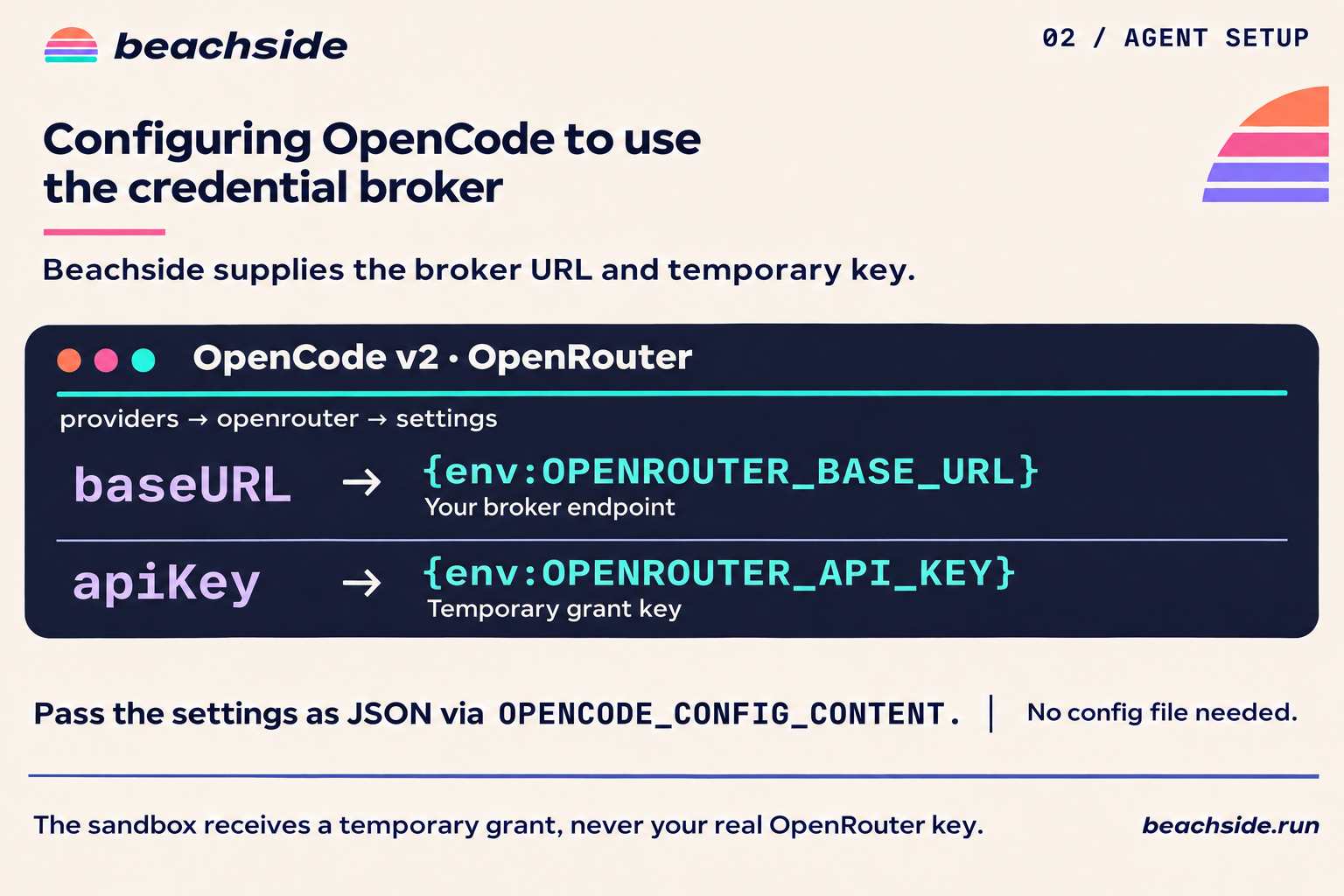
Section titled “OpenCode”OpenCode reads variable references in its configuration, so it can use the grant directly. Add the providers your grant includes to opencode.json or .opencode/opencode.json in the project. OpenCode configuration, OpenCode providers.
{ "$schema": "https://opencode.ai/config.json", "providers": { "openrouter": { "settings": { "baseURL": "{env:OPENROUTER_BASE_URL}", "apiKey": "{env:OPENROUTER_API_KEY}" } } }}OpenCode v2.2.7 also takes the same JSON through OPENCODE_CONFIG_CONTENT in the environment of the command that starts it. Keep the {env:...} references. OpenCode CLI environment variables.
The compiled OpenCode example sets up both integrations, clones a project and starts OpenCode with the grant.
GitHub Actions
Section titled “GitHub Actions”On a GitHub Actions runner, issue grants with the job’s OIDC token instead of an issuer key. See GitHub Actions.
© 2026 Beachside Compute · Made by humans & in Texas